Structuring Your Talk: The Introduction-Body-Conclusion Framework for a 15-Minute Presentation
The thought of giving a presentation can be daunting, especially when you’re staring down a strict 15-minute duration. How do you fit all your ideas, data, and stories into such a tight window without rushing or sounding disorganized? The secret isn’t in cramming; it’s in a timeless, three-part framework: the Introduction, the Body, and the Conclusion.
This structure is a powerful planner for your entire talk. It provides a clear road map for both you and your audience, ensuring your speech is not just delivered, but truly understood. At Slide Coach, we believe this framework is the key to effective time management and a confident delivery.
Part 1: The Presentation’s Introduction (2-3 Minutes)
The first few minutes of your presentation are the most important. This is your chance to grab your audience’s attention, build credibility, and set the stage for your core message. Think of it as a preview of the movie you’re about to show.

What to include:
- The Hook (30 seconds): Start with something that grabs your audience’s attention. This could be a surprising statistic, a thought-provoking question, or a short, relatable story. The goal is to make them immediately interested in what you have to say.
- Your Core Message (30 seconds): After the hook, clearly and concisely state the one main thing you want your audience to remember. As we discussed in our last post, this is the central idea of your entire talk.
- The Road Map (1 minute): Tell your audience exactly what you will be covering. A simple statement like, “Today, we’ll explore three key areas: the problem, our solution, and the benefits,” gives them a clear structure to follow. This is crucial for time management as it prevents you from rambling and keeps you on track.
- Establish Credibility (30 seconds): Briefly explain who you are and why you’re qualified to speak on this topic. Be humble but confident.
Slide Coach Tip: Use our calculator as your planner for this section. A 2-3 minute introduction should be roughly 280-420 words, depending on your speaking rate.
Part 2: The Presentation’s Body (10-12 Minutes)
This is the core of your presentation. It’s where you provide the evidence, data, and stories that support your core message. For a 15-minute talk, you’ll want to focus on 2-3 main points. Trying to cover more will force you to rush and sacrifice clarity.
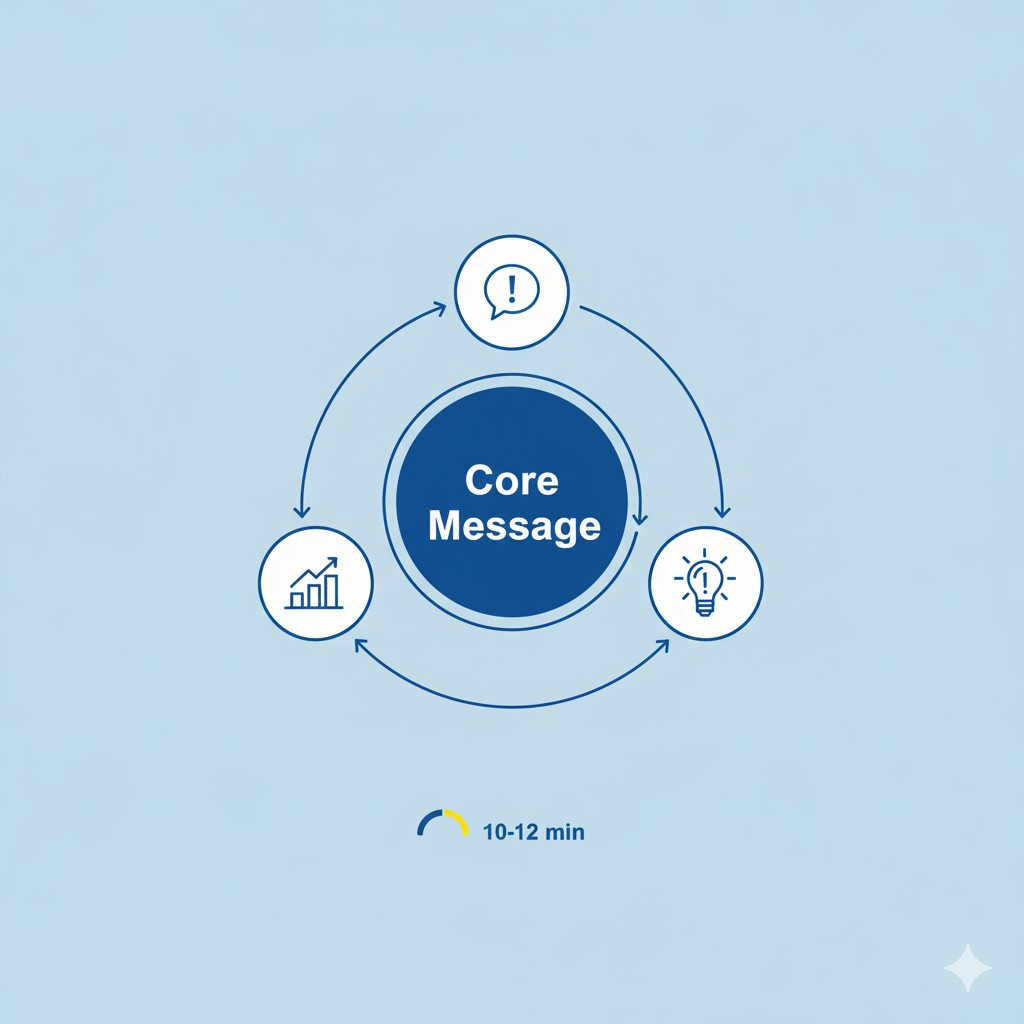
How to structure it:
- Focus on One Point Per Slide: Avoid putting too much information on a single PowerPoint slide. Each slide should have a clear, simple message that reinforces one of your main points.
- Tell a Story with Your Data: Don’t just show a graph and move on. Explain what the data means, why it matters, and how it connects back to your core message. Use your “visual time” in the Slide Coach calculator to account for these moments.
- Transitions are Key: Use clear phrases to move from one point to the next, like “Now that we’ve covered the problem, let’s look at the solution.” This helps your audience follow the flow of your slideshow and feel more engaged.
Slide Coach Tip: Use our time management ppt tool to analyze this section. With a 10-12 minute duration, you should aim for about 1,400-1,680 words. If you upload your PDF or PowerPoint and see a higher word count, it’s a sign you need to simplify and focus on your core message.
Part 3: The Talk’s Conclusion (1-2 Minutes)
A great conclusion doesn’t just end the presentation; it solidifies your message and leaves a lasting impression. This is not the time to introduce new information.

What to include:
- Restate Your Core Message (30 seconds): Remind your audience of the one thing you want them to remember. Rephrase it slightly so it sounds fresh and impactful.
- Summarize Your Main Points (1 minute): Briefly recap the 2-3 key points you covered in the body. This helps reinforce the information and makes it easier for your audience to recall.
- Call to Action (30 seconds): Tell your audience what you want them to do next. This could be as simple as, “Please visit our website,” or “I encourage you to try this new approach.” This gives your talk a purpose and an actionable outcome.
Slide Coach Tip: This section should be short and powerful. Aim for a word count that fits within a minute or two, so you don’t rush the ending.
y using this introduction-body-conclusion framework, you’ll be able to create a structured, engaging, and perfectly timed talk for any class presentation, meeting, or conference. And with the help of the Slide Coach app, you’ll have the perfect planner to guide you every step of the way.
The Slide Coach Solution
This is where the Slide Coach app becomes your secret weapon. As you build your presentation, our calculator can serve as your personal planner. You can upload your PowerPoint or PDF file to see how your word count affects your total duration. This immediate feedback helps you identify slides that contain too much text, allowing you to edit down your content and stay focused on your core message.
Our words per minute slider and “visual time” feature give you the power to adjust your pace for emphasis or add moments for audience engagement. This makes it a great time management ppt tool for any professional. By using Slide Coach to get a clear picture of your talk’s length, you can confidently cut out what’s not essential and ensure your final presentation is not only perfectly timed, but also perfectly unforgettable.
Your core message is your promise to the audience. It’s the valuable takeaway you’re offering them. By defining it early and using tools like the Slide Coach calculator, you ensure your presentation is not only perfectly timed, but also perfectly unforgettable.
Frequently Asked Questions About introduction-body-conclusion structure
Why is the introduction-body-conclusion structure so important for a 15-minute presentation?
This classic three-part framework is crucial because it provides a clear, logical flow for your presentation, making it easy for your audience to follow and remember your message. For a tight 15-minute duration, it’s an essential planner that helps with time management
How much time should I dedicate to each part of my presentation: introduction, body, and conclusion?
For a 15-minute talk, a good guideline is: * Introduction: 2-3 minutes (to hook your audience, state your core message, and provide a road map). * Body: 10-12 minutes (for your main points, evidence, and stories). * Conclusion: 1-2 minutes (to summarize and provide a call to action). * This breakdown, which you can track with the Slide Coach calculator, helps you manage your PowerPoint or PDF content efficiently.
What is the most common mistake speakers make when structuring their talks, and how can I avoid it?
The most common mistake is trying to cram too much information into the presentation, especially in the body section. This leads to rushing, confusion, and exceeding the time limit. To avoid this, focus on 2-3 main points in the body, use one main idea per slide, and remember that anything that doesn’t directly support your core message should be cut. The Slide Coach time management ppt feature can help you pinpoint where you might be overloading your content.
How can the SlideCoach.app help me stick to this 15-minute framework?
The Slide Coach app acts as your personal planner and speaking rate analyzer. By uploading your PowerPoint or PDF file, you can get an immediate estimate of your speech duration based on your words per minute. This allows you to adjust content, ensure each section fits its allocated time, and strategically plan “visual time” for impactful slides without going over your 15-minute limit.
What’s the main goal of the conclusion, and why is it important not to introduce new information there?
The main goal of the conclusion is to reinforce your core message and leave a lasting impression. It’s where you restate your main idea, summarize key points, and give a clear call to action. Introducing new information here can confuse your audience and dilute the impact of your presentation. A strong conclusion ensures your talk ends powerfully and purposefully, exactly when it should.