How to write a Core Message for a Presentation That Sticks
Have you ever left a presentation feeling overwhelmed and unsure what the speaker was even trying to say? You nod along, maybe even take a few notes, but by the end, you can’t remember the point. It’s a common problem, and it’s a failure not of the audience, but of the speaker. In a world of fast-paced meetings and strict conference schedules, it’s easy to pack too much information into your PowerPoint slides, Keynote or PDF file. The secret to a talk that leaves a lasting impression isn’t about cramming in every single fact; it’s about finding one clear, powerful idea. This is your core message, and it is the single most important element of any speech. Learn how to how to create a strong presentation message and improve effective presentation skills and deliver the main message of a presentation so people will remember your presentation key takeaway.
What Is a Core Message? The Guiding Star of Your Talk
Have you ever left a presentation wondering what the speaker was really trying to say? Maybe you nodded along, maybe you took a few notes, but by the end, the main point was gone. This happens not because the audience isn’t listening—but because the speaker failed to deliver a clear core message.
In today’s fast-paced world of meetings, classes, and conferences, audiences don’t want endless slides and scattered facts. They want clarity. And clarity begins with a single, powerful idea: your core message.
Think of your core message as the single, unforgettable sentence that your entire slideshow is built on. It’s the North Star that guides your speech from the very first word to the very last. It answers the most important question your audience has: “Why should I care about this?” Without a clear core message, your talk can feel like a jumble of random facts, making it difficult for your audience to follow your argument and remember your key points.
A strong core message acts as a central hub. Every slide you create, every piece of data you share, and every story you tell should connect back to this one idea. This helps your audience make connections and process information more easily. It’s the difference between a speaker who just presents information and a speaker who inspires action or a change in thinking. Your core message is what turns information into inspiration.
What Is a Core Message in a Presentation?
A core message is the central idea that your entire presentation is built on. It’s the takeaway you want your audience to remember long after your final slide.
- It answers: “Why should I care?”
- It keeps your talk focused and easy to follow.
- It ensures that your audience remembers one big idea, not just random details.
Think of it like a compass. Every slide, story, or piece of data should point back to this one direction.
👉 Example:
- ❌ Weak: “I’ll cover our company’s growth, our new campaign, and next year’s goals.”
- ✅ Strong: “Our digital strategy will double sales in the next 12 months.”
Why a Core Message Matters
Without a clear core message, your talk risks becoming a jumble of facts. With one, your presentation becomes:
- Clear – your audience immediately knows what matters.
- Memorable – people walk away with a single, powerful idea.
- Focused – you stay on track and avoid information overload.
- Impactful – instead of confusion, your talk inspires action.
Think about history’s greatest speeches. Martin Luther King Jr.’s message wasn’t “civil rights policy proposals.” It was unforgettable: “I have a dream.”
How to Craft Your Core Message
Finding your core message is the first and most critical step of a successful presentation. It’s the starting point for your planner and the foundation for great time management. Here’s a simple three-step process to help you find it.
Start with “Why”: Don’t focus on what you’re going to say, but rather why you’re saying it. This is a common pitfall. Too many speakers start with their data or their bullet points. Instead, take a step back and ask yourself:
👉 Example: In a sales pitch, your “why” might be:
“Switching to our platform saves $50,000 a year.”
Focus on the Audience: Your core message isn’t for you—it’s for them. It must be framed from their perspective. What new insight, tool, or belief will they leave with?
👉 Example:
- For executives: “Our solution protects your reputation as much as your revenue.”
- For students: “Math isn’t about numbers—it’s about solving real problems.”
Condense into One Sentence: This is the ultimate test. Take your idea and condense it into a single, powerful sentence. If you find yourself adding extra details or using words like “and,” “but,” or “also,” it’s a sign that you have more than one message. Keep simplifying until it’s just one idea. This forces you to be concise and focused, which is a key skill for any talk that has a tight duration.
If it takes more than one sentence, it’s too complicated. Test your message:
Would someone remember it tomorrow?
Can a 12-year-old understand it?
👉 Example:
- ❌ Too broad: “We’ll improve efficiency, reduce costs, and increase satisfaction.”
- ✅ Focused: “This project cuts wasted time in half.”
- Too broad: “I will talk about our company’s new marketing strategy and the results of our Q3 campaign, and also our plan for next year.”
- More focused: “Our new strategy to use social media influencers can boost sales by 30%.” The focused version is not only easier to remember, it’s also a powerful promise you can deliver on.
- In a sales pitch, your “why” might be:“Switching to our platform saves $50,000 a year.”
The focused version is not only easier to remember, it’s also a powerful promise you can deliver on.
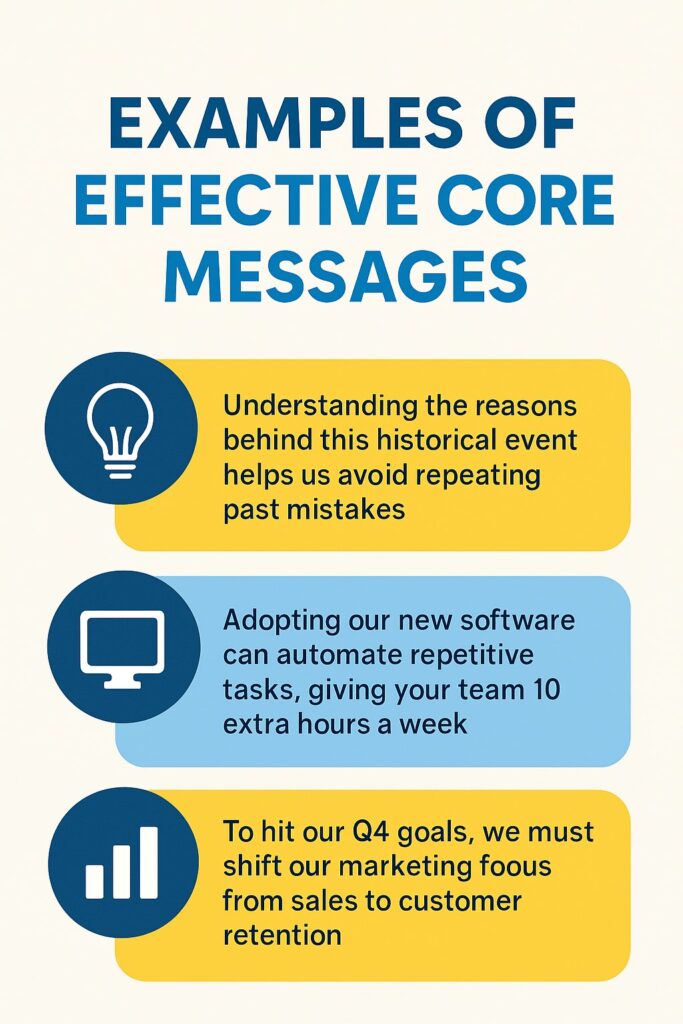
Examples of Strong Core Messages
Here are clear, memorable core messages across different fields:
- Healthcare: “Preventing disease saves more lives than curing it.”
- Technology: “AI can cut customer wait times from hours to seconds.”
- Nonprofit: “Every $1 provides 10 meals to families in need.”
- Education: “History helps us avoid repeating past mistakes.”
Each one is short, audience-focused, and easy to remember.
Building Your Presentation Around the Message
Once you have your core message, every slide in your PPT slideshow should support it. Every piece of data, every quote, and every story should be a building block that strengthens that single idea. If a slide doesn’t help you prove your point, it should be removed. This is a powerful technique for time management, especially for a 10-20 minute duration where every second counts.
Your presentation should have a clear structure based on your core message.
- Introduction: Hook the audience and state your core message.
- Body: Provide evidence and examples (each on a separate slide) that support your core message.
- Conclusion: Summarize your key points and restate your core message in a memorable way.
The Problem with No Core Message
The most common reason speakers run out of time is trying to say too much. When your presentation lacks a clear core message, you feel compelled to include every single detail, just in case. This leads to a rushed delivery, where you talk too fast and fail to make a lasting connection. You might sound like a robot reading off a PDF or a script, instead of a passionate speaker sharing a great idea.
When you don’t know what to cut, you often end up cutting nothing at all, which hurts the overall quality of your speech. You go over your duration, and you lose the audience’s attention.
Skipping your core message leads to:
- Confusion: your audience struggles to connect the dots.
- Overload: too many details, not enough clarity.
- Forgettable talks: people remember slides, but not your point.
- Lost impact: you worked hard, but your message doesn’t land.
The Slide Coach Solution
This is where the Slide Coach app becomes your secret weapon. As you build your presentation, our calculator can serve as your personal planner. You can upload your PowerPoint or PDF file to see how your word count affects your total duration. This immediate feedback helps you identify slides that contain too much text, allowing you to edit down your content and stay focused on your core message.
Our words per minute slider and “visual time” feature give you the power to adjust your pace for emphasis or add moments for audience engagement. This makes it a great time management ppt tool for any professional. By using Slide Coach to get a clear picture of your talk’s length, you can confidently cut out what’s not essential and ensure your final presentation is not only perfectly timed, but also perfectly unforgettable.
Your core message is your promise to the audience. It’s the valuable takeaway you’re offering them. By defining it early and using tools like the Slide Coach calculator, you ensure your presentation is not only perfectly timed, but also perfectly unforgettable.
Frequently Asked Questions About Core Messages in Presentations
What is a core message in a presentation?
A core message is the single most important idea you want your audience to remember. It’s the heart of your talk and everything else should connect back to it.
Why is a core message important?
Without a clear core message, your presentation can feel confusing and forgettable. With one, your talk is focused, easy to follow, and more likely to inspire action.
How do I create a strong core message?
Start by asking what you want your audience to think, feel, or do after your talk. Then, write it down in one clear, short sentence.
Can I have more than one core message?
No. If you try to share more than one, your audience won’t remember either. Stick to one clear idea. You can support it with data, stories, or examples, but the core must stay singular.
How long should a core message be?
Just one sentence. If it takes more than that, it’s too complicated. Aim for something short, clear, and memorable.